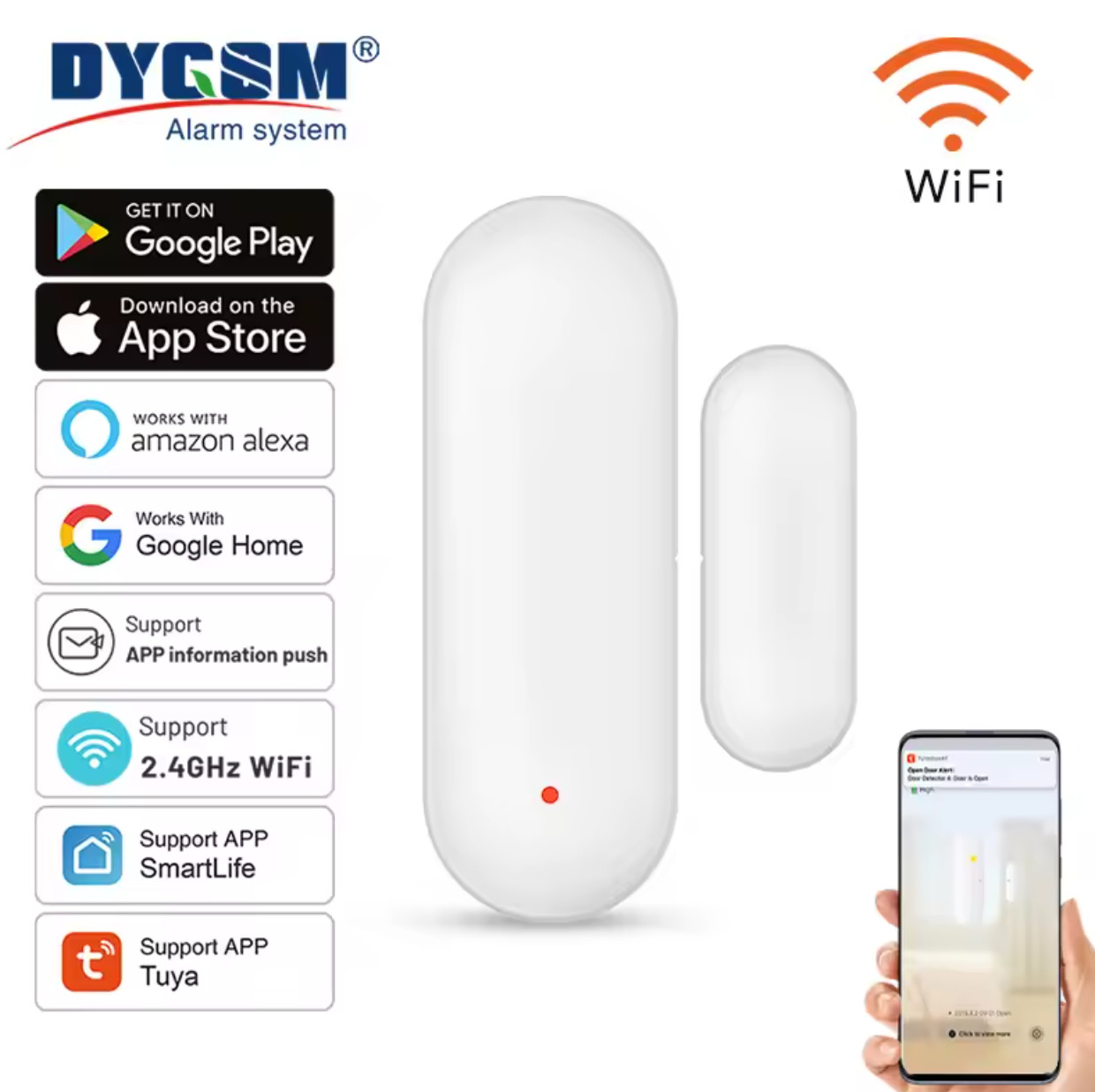

Photos from current listings. Actual item, color, and included accessories may vary.
Sensor Tuya Smart Buying Guide
Tuya smart sensors are low-power Zigbee or Wi-Fi devices that report door/window state, temperature, humidity, motion, or water leaks to the Smart Life / Tuya Smart app for automation and remote alerts. The core trade-off is protocol: battery Zigbee sensors last 1-2 years on a coin cell and mesh reliably, while Wi-Fi sensors need more frequent battery changes or constant USB power but skip the hub. Buy Zigbee if you are building a multi-sensor system with a hub; buy Wi-Fi only for a single standalone sensor near your router.
At a glance
- Category
- Home Security
- Status
- Listings available
- Last updated
- Nov 22, 2026
Current offers
Highlights
- Zigbee 3.0 sensors pair to a Tuya Zigbee gateway (USB dongle or hub) and mesh to extend range; Wi-Fi sensors connect directly to a 2.4 GHz router with no hub.
- Door/window sensors use a reed switch rated for roughly 10-30 mm gap closure; mounting misalignment beyond that gap causes false 'open' states.
- Coin-cell Zigbee sensors (CR2032/CR2477) typically run 12-24 months; Wi-Fi door sensors often drop to 3-6 months because the radio stays associated.
- Temperature/humidity sensors report at ±0.3-0.5 °C and ±3-5% RH; accuracy tier matters more than app features for HVAC and greenhouse use.
Best use cases
- Best fit: whole-home door/window and leak coverage — pick Zigbee 3.0 sensors plus a Tuya Zigbee gateway for mesh range and 1-2 year battery life.
- Best fit: single-room renter or apartment — a Wi-Fi door sensor or Wi-Fi temp/humidity sensor works without buying a hub, at the cost of shorter battery life.
- Best fit: HVAC, nursery, or greenhouse monitoring — choose a dedicated temp/humidity sensor with stated ±0.5 °C accuracy and local display or app history.
- Wrong fit: outdoor gates and mailboxes — most Tuya sensors are IP20 indoor-rated; exposed rain and sub-zero cold will kill coin-cell chemistry and reed reliability.
Buying tips
- Count your planned sensors first: three or more Zigbee sensors justify a gateway; one or two standalone sensors are cheaper and simpler on Wi-Fi.
- Confirm 2.4 GHz Wi-Fi only — Tuya Wi-Fi devices do not join 5 GHz SSIDs, so a mixed-band router must expose a separate 2.4 GHz network during pairing.
- Match battery type to placement: CR2477 cells give longer life but are less common; standard CR2032 keeps replacement cheap and easy.
- For door sensors, check frame depth and gap: the magnet must sit within 10-30 mm of the sensor body when the door is closed, or the contact will never report 'closed'.
Specs
| Radio Protocol | Wi-Fi 2.4 GHz / Zigbee 3.0 / Bluetooth |
|---|---|
| Hub Requirement | None (Wi-Fi) / Zigbee-BT gateway |
| Battery Life | Wi-Fi 6-12 mo / Zigbee 12-24 mo |
| Magnet Gap | 15-25 mm rated trigger distance |
Alternatives to compare
Related searches
What to check before buying
- Measure the door/window frame: sensor body plus magnet must fit the frame face with the gap under 25 mm when closed — check hinge-side vs handle-side clearance.
- Confirm 2.4 GHz Wi-Fi coverage at the door and that the router SSID is not 5 GHz-only or WPA3-only, which blocks Tuya pairing.
- For Zigbee, place the hub centrally or add a mains-powered Zigbee router (plug, bulb) within two hops of far sensors.
- Verify the app region and account: Tuya/Smart Life devices pair to one account and one data region; cross-region sharing breaks automations.
FAQ
Data sources: eBay / Amazon listings and product attribute feeds. Updated Nov 22, 2026.
Some links on this page are affiliate links. If you buy after clicking one, we may earn a commission at no extra cost to you. This does not change which products appear here or their order. Affiliate disclosure.