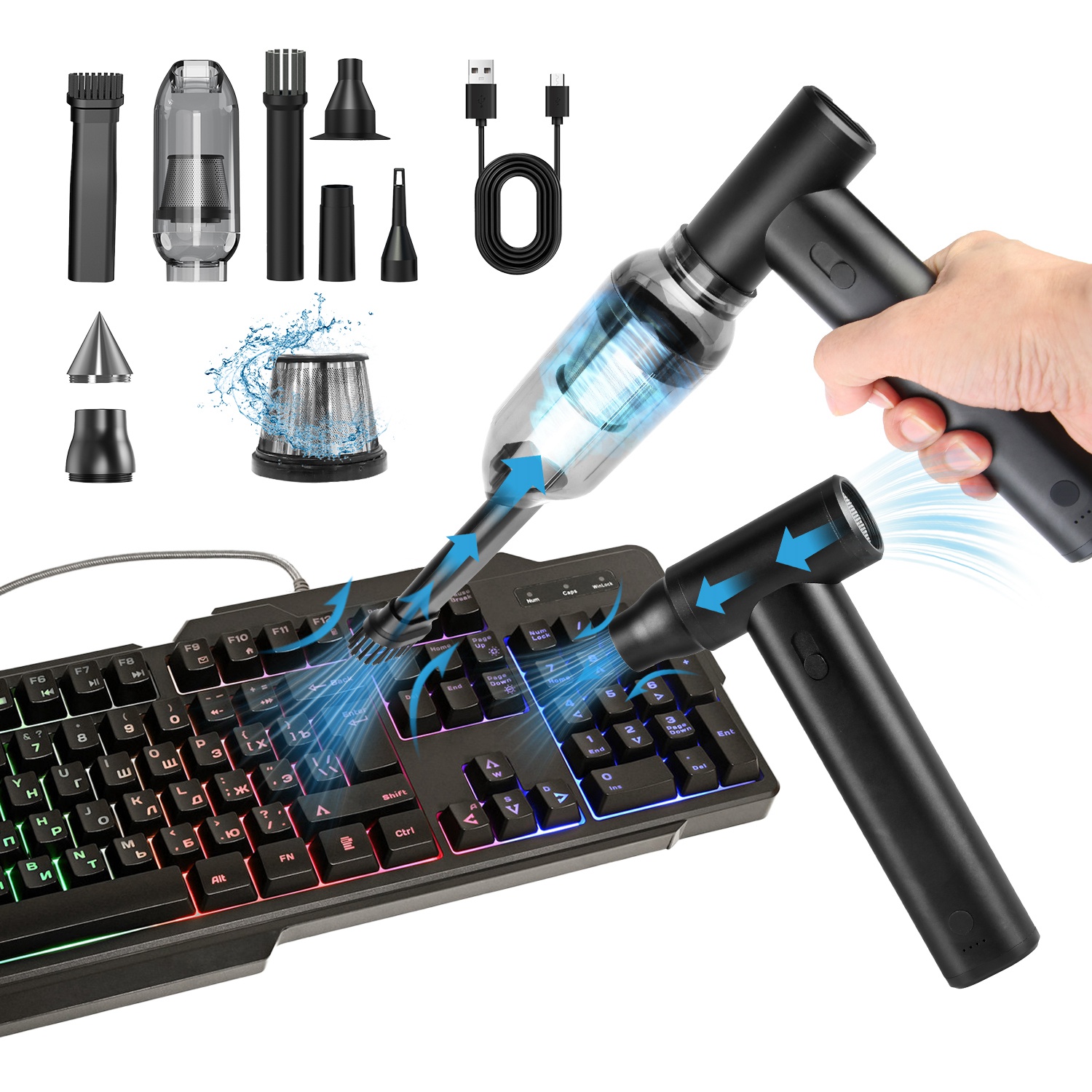

Photos from current listings. Actual item, color, and included accessories may vary.
Portable Car Vacuum Buying Guide
Portable car vacuums are compact, battery-powered or 12V corded cleaners for vehicle interiors and quick household spot-cleaning. The decisive trade-off is suction power versus runtime and portability: brushed motors with small sealed lead-acid cells are cheap but weak and short-lived, while brushless motors with lithium-ion packs deliver real airflow and multi-season durability. Buy brushless with a swappable or USB-C charged lithium pack and a washable HEPA-style filter; treat any sub-100W brushed unit with a built-in non-replaceable battery as a disposable compromise.
At a glance
- Category
- Smart Cleaning
- Last updated
- Nov 22, 2026
Current offers
Highlights
- Brushless DC motors spin 50,000-250,000 RPM and convert power to airflow more efficiently than brushed motors, which wear out carbon brushes within a few dozen hours.
- Lithium-ion packs (typically 2,000-4,000mAh, 7.2-12V) deliver 15-30 minutes of full suction; sealed lead-acid cells add weight and lose capacity after roughly 200-300 cycles.
- Suction is rated in kPa (10-20kPa is strong for handheld car vacuums) or air watts; below 6kPa struggles with embedded floor-mat grit.
- A true HEPA or washable pleated filter traps fine dust; cheap foam-only filters pass particles back into cabin air and clog quickly.
Best use cases
- Best fit: daily driver with kids or pets — pick a brushless cordless unit rated 12kPa+ with a 2,500mAh+ lithium pack and washable filter for weekly floor-mat and seat cleaning.
- Best fit: deep detailing and wet spills — choose a 12V corded vacuum with a 5m cable and 500ml+ dust cup; skip battery units that lack liquid shutoff.
- Wrong fit: heavy workshop or garage cleanup — a handheld car vacuum's 0.3-1L cup and 20-minute runtime cannot replace a 5-gallon wet/dry shop vac.
- Wrong fit: full-size SUV or van with three rows — compact 0.5L cups require multiple empties; pick a larger canister or corded 12V unit with a longer hose.
Buying tips
- Match motor type to duty cycle: brushless for repeated 20-minute sessions and long life; brushed only for occasional light use at the lowest cost tier.
- Size the battery to the job: 2,000mAh gives about 15 minutes, 4,000mAh about 30 minutes; a removable pack lets you carry a spare instead of waiting to recharge.
- Check the 12V plug standard: corded units draw 10-15A, so verify your car's accessory socket fuse rating (typically 15A) and use the engine-running mode to avoid draining the battery.
- Confirm filter availability: pleated HEPA-style filters should be washable and sold as replacements; a vacuum with a proprietary disposable filter becomes e-waste when stock dries up.
Specs
| Motor Type | Brushless DC vs Brushed |
|---|---|
| Power Source | 12V corded vs Li-ion cordless |
| Suction Rating | 6-20 kPa (10kPa+ for mats) |
| Runtime / Capacity | 15-30 min / 0.3-1L dust cup |
Related searches
What to check before buying
- Measure your 12V socket location and cable run: a 3-5m cord must reach the trunk and rear footwells without straining the plug.
- Verify the charging standard: USB-C PD charging is universal; proprietary barrel chargers mean one more cable in the car.
- Check dust-cup capacity against your vehicle: 0.5L or more for a sedan, 1L+ for SUVs and pet owners to avoid constant emptying.
- Confirm nozzle and brush accessories include a crevice tool for seat rails and a soft brush for screens and vents.
FAQ
Data sources: eBay / Amazon listings and product attribute feeds. Updated Nov 22, 2026.
Some links on this page are affiliate links. If you buy after clicking one, we may earn a commission at no extra cost to you. This does not change which products appear here or their order. Affiliate disclosure.