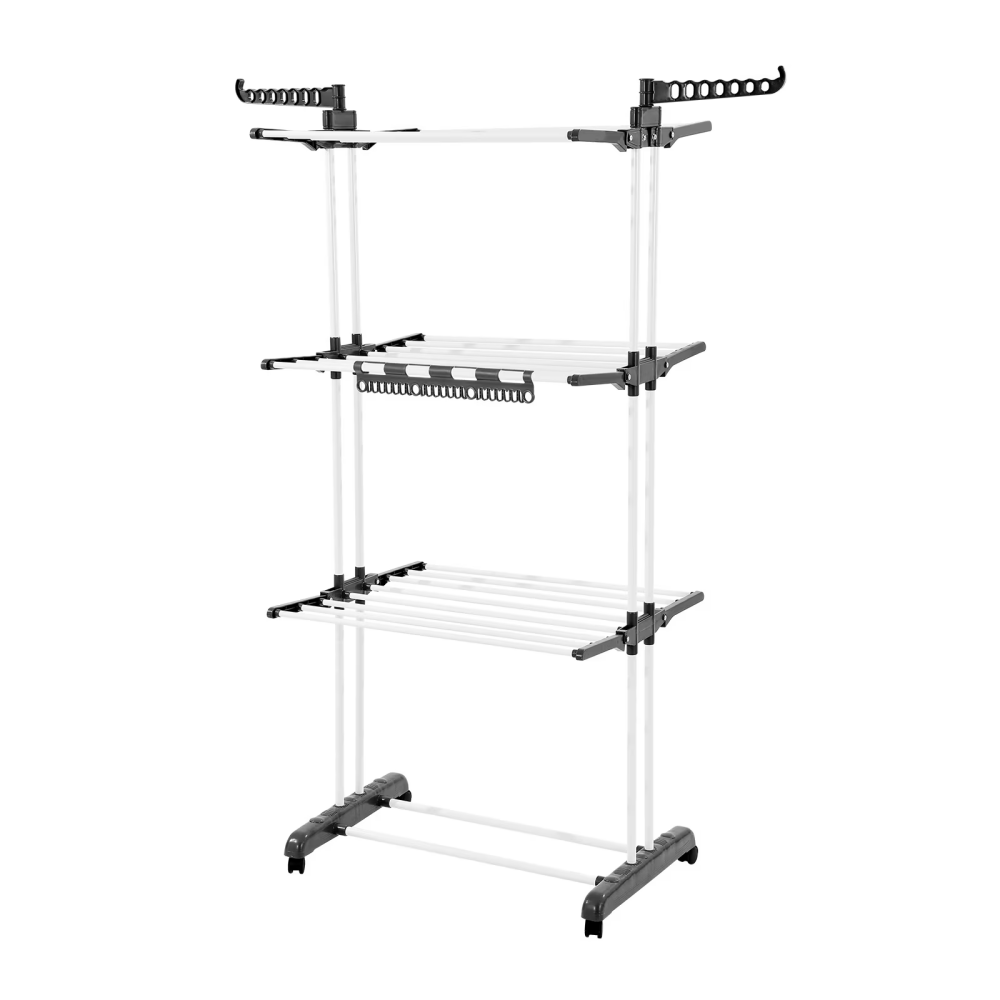

Photos from current listings. Actual item, color, and included accessories may vary.
Indoor Drying Rack Buying Guide
An indoor drying rack is a freestanding or wall-mounted system for air-drying clothes without a tumble dryer, defined by its frame material, drying surface area, and folding mechanism. The core trade-off is between lightweight portability and load capacity: thin aluminum or low-grade steel racks fold flat but sag under wet denim, while solid wood or reinforced steel racks hold heavy loads but occupy fixed floor space. The decision rule is simple: buy for the wet weight of your heaviest load and your available drying footprint, not for the lowest folded profile.
At a glance
- Category
- Laundry & Garment Care
- Last updated
- Nov 22, 2026
Current offers
Highlights
- Frame material dictates durability: solid beech or birch dowels resist warping when wet, while hollow aluminum or thin-gauge steel rusts at joints within a few seasons.
- Tier count and rod spacing determine capacity: 3-4 tiers with 20-24 rods hold a full family load, while 2-tier racks suit single-person laundry.
- Locking casters vs fixed feet separate portable racks from semi-permanent ones; locking wheels allow repositioning and secure the rack under load.
- Wing-style foldable arms collapse inward for storage; accordion and wall-mounted designs trade floor space for permanent mounting hardware.
Best use cases
- Best fit: a 4-tier wheeled rack with 24 rods and locking casters for a family of 3-4 drying a full load of shirts, towels, and delicates in a spare room or balcony.
- Best fit: a compact 2-tier accordion rack for a single renter with limited floor space who air-dries 5-8 garments at a time and stores the rack in a closet.
- Wrong fit: skip lightweight aluminum A-frame racks for heavy items like wet jeans and bedding—the crossbars bow and the hinge rivets loosen under sustained load.
- Wrong fit: skip wall-mounted racks in rental units or plaster walls unless you can anchor into studs; they are permanent and load-limited by the wall substrate.
Buying tips
- Match rack capacity to wet load weight: a full washer load of cotton towels can exceed 15-20 lbs wet, so choose a rack rated for at least 25 lbs total.
- Measure your drying zone first: a 4-tier rack with wings extended needs roughly 2-3 ft of depth and 4-5 ft of width; confirm door and hallway clearance for wheeled models.
- Choose solid wood (beech/birch) or powder-coated steel over unfinished pine or thin aluminum; wood dowels should be at least 0.6 in diameter to prevent bowing.
- For balconies and bathrooms, prioritize rust-resistant finishes (powder-coated steel, sealed wood) and locking casters so the rack stays put on tile or decking.
Specs
| Frame Material | Solid wood / powder-coated steel |
|---|---|
| Tier & Rod Count | 2-4 tiers / 12-24 rods |
| Load Capacity | 15-40 lbs wet laundry |
| Mobility & Fold | Locking casters / foldable wings |
Related searches
What to check before buying
- Measure the floor footprint with wings fully open and confirm the rack fits your drying area without blocking walkways or doors.
- Check the load rating against your heaviest wet load; wet denim and towels are the stress test, not dry shirts.
- Confirm caster type: locking wheels for hard floors, standard casters may scratch wood or slide on tile.
- For wall-mounted racks, verify wall substrate (stud vs drywall vs plaster) and included mounting hardware before purchase.
FAQ
Data sources: eBay / Amazon listings and product attribute feeds. Updated Nov 22, 2026.
Some links on this page are affiliate links. If you buy after clicking one, we may earn a commission at no extra cost to you. This does not change which products appear here or their order. Affiliate disclosure.