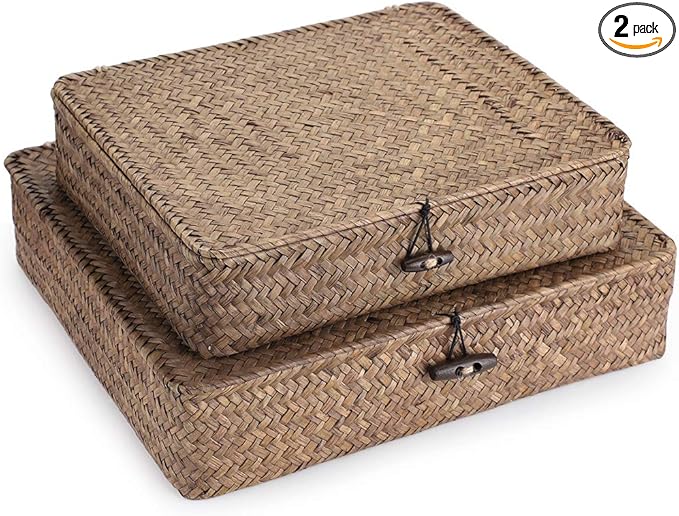

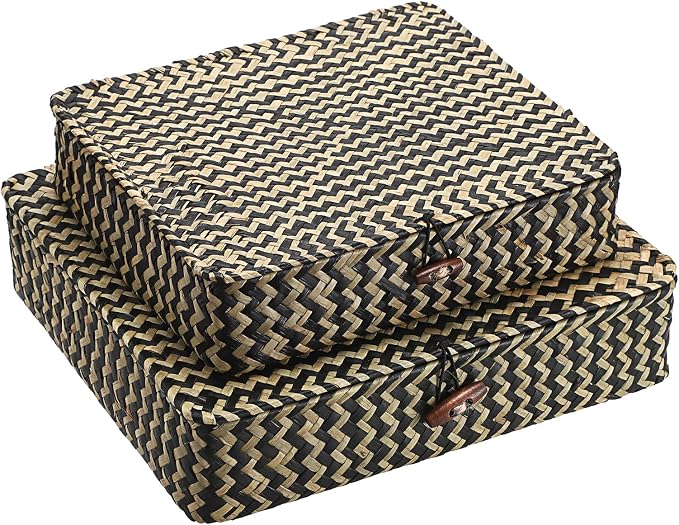
Photos from current listings. Actual item, color, and included accessories may vary.
Wicker Basket Buying Guide
Wicker baskets are woven storage vessels made from natural or synthetic fibers, where the core trade-off is breathable, decorative natural weave versus moisture-resistant, shape-holding synthetic construction. Buyers should choose hand-woven seagrass or willow for covered, dry-room aesthetics and machine-woven polyrattan or coated wire for humid rooms and heavy loads. The decision rule: match fiber to humidity and weave density to load, and always size the basket to the shelf or floor footprint before ordering.
At a glance
- Category
- Home Storage & Organization
- Last updated
- Nov 22, 2026
Current offers
Highlights
- Natural seagrass and willow breathe and patina but soften and mold above 60% humidity; polyrattan and coated wire hold shape in bathrooms and basements.
- Weave density determines load: tight flat-weave seagrass with a solid base supports 10-15 lb; open loose weave needs a liner for small items.
- Lidded flat baskets stack two to three high and hide clutter; open handles favor blanket and toy duty where quick access matters.
- Seagrass is a fast-renewable crop and fully compostable; polyrattan is UV-stabilized for outdoor and sunroom use but is petroleum-based.
Best use cases
- Blanket and throw storage in a dry living room: pick a large lidded seagrass basket of at least 18 in wide by 12 in deep so a folded queen throw fits without compression.
- Bathroom or laundry organization: choose polyrattan or coated-wire baskets with a removable liner; skip natural seagrass, which warps and mildews in steamy rooms.
- Closet shelf and bedroom tidying: use flat, lidded seagrass boxes sized to the shelf depth (typically 12-14 in) for stacked, dust-free storage of linens and accessories.
- Skip wicker entirely for garage, shed, or outdoor exposure unless the basket is explicitly UV-stabilized polyrattan; natural fibers crack and fade within a season.
Buying tips
- Measure shelf depth and opening height first; flat lidded baskets run 12-14 in deep, and a basket wider than the shelf overhangs and tips.
- For blankets, choose at least 18 in wide by 12 in deep and 12 in tall; smaller ‘large’ baskets compress throws and crease fabrics.
- Check the base: a reinforced board or tight flat weave supports 10-15 lb; loose open weave needs a fabric liner for small items.
- Prefer hand-woven seagrass with tied or stitched rims over glued rims; stitched rims resist unraveling and last years longer.
Specs
| Weave Material | Seagrass / Willow / Polyrattan |
|---|---|
| Construction | Hand-woven vs Machine-woven |
| Lid Type | Lidded flat vs Open-top |
| Load Capacity | 10-15 lb (tight weave, solid base) |
Related searches
What to check before buying
- Measure shelf depth, opening height, and floor footprint; confirm the basket’s exterior dimensions, not just interior capacity.
- Assess room humidity: below 60% suits natural seagrass and willow; bathrooms, basements, and kitchens need polyrattan or coated wire.
- Confirm the basket has a solid base or liner if storing small items, and check rim construction for stitched versus glued edges.
- For lidded stacking, verify the lid seats flat and the basket sides are rigid enough to bear the weight of a second loaded basket.
FAQ
Data sources: eBay / Amazon listings and product attribute feeds. Updated Nov 22, 2026.
Some links on this page are affiliate links. If you buy after clicking one, we may earn a commission at no extra cost to you. This does not change which products appear here or their order. Affiliate disclosure.