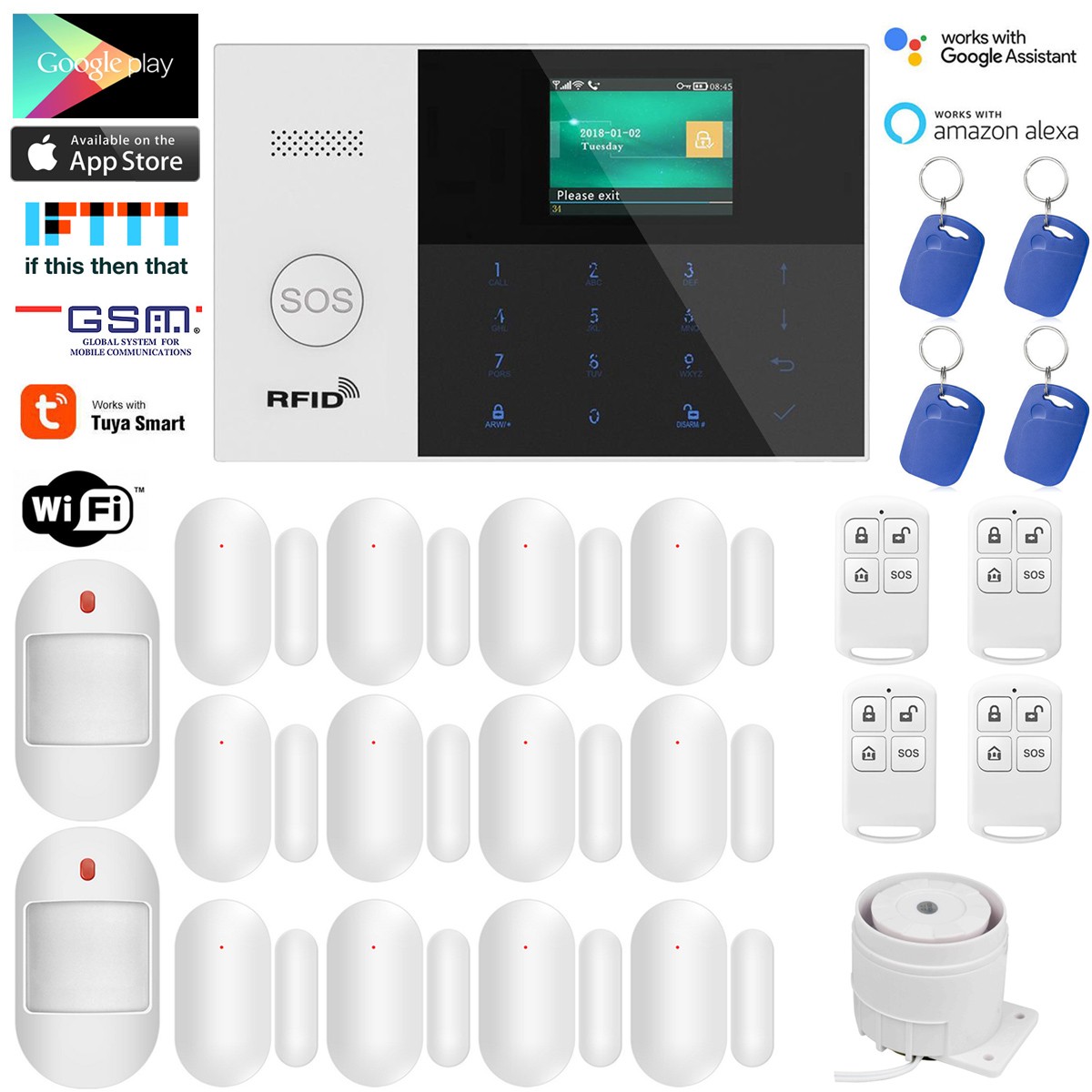

Photos from current listings. Actual item, color, and included accessories may vary.
Wireless House Alarm Buying Guide
A wireless house alarm is a self-contained intrusion-detection system where sensors and the siren/hub communicate over RF (433/868 MHz), Wi-Fi, or cellular GSM rather than through wired loops. The central trade-off is between fully wireless convenience (fast install, but battery and signal-range constraints) and hybrid reliability (wired siren power with wireless sensors). The decision rule: buy a system with dual-path communication (Wi-Fi plus GSM) and monitored or app-based alerts; skip single-path Wi-Fi-only kits for primary security because they fail when the internet or power drops.
At a glance
- Category
- Home Security
- Last updated
- Nov 22, 2026
Current offers
Highlights
- RF sensor bands: 433 MHz is common and long-range but congested; 868 MHz offers better interference rejection and is preferred in dense urban RF environments.
- Communication path tiers: Wi-Fi-only hubs are cheapest but drop alerts during outages; Wi-Fi + GSM dual-path hubs maintain alarm signaling over cellular when broadband fails.
- Hub battery backup: a built-in rechargeable backup (typically 6–12 hours) keeps the siren and GSM alive during mains power loss; hubs without backup are notification-only toys.
- Sensor types and tiers: PIR motion sensors detect body heat across roughly 8–12 m with 90–110° coverage; door/window contacts use magnetic reed switches; glass-break sensors add acoustic detection for perimeter glass.
Best use cases
- Best fit: renters and quick-install households — pick a fully wireless Wi-Fi + GSM hub kit with peel-and-stick PIR and door contacts; skip wired panels that require drilling and landlord approval.
- Best fit: apartments and small homes up to ~100 m² — one hub plus 4–6 sensors covers entry points and a main hallway; skip multi-room expansion kits with 20+ sensors that exceed the hub's RF device limit.
- Best fit: remote or off-grid properties — choose a GSM-primary hub with battery backup and SIM slot; skip Wi-Fi-only systems that go silent when the router loses power.
- Wrong fit: high-security or insurance-mandated installs — those require professionally monitored, wired or hybrid panels with certificate-grade signaling; a DIY Tuya-style app kit does not satisfy monitoring contracts.
Buying tips
- Match hub capacity to sensor count: entry-level hubs support 20–50 RF devices; count every door, window, PIR, and remote, then keep 30% headroom for future sensors.
- Check the RF band and pairing protocol: sensors from one band (433 vs 868 MHz) do not pair with a hub on the other; Tuya/Smart Life app ecosystems ease cross-brand sensor pairing.
- Prioritize dual-path signaling: Wi-Fi plus GSM (2G/4G SIM) is the practical minimum for real intrusion alerts; single-path Wi-Fi kits are lifestyle notifications, not security.
- Verify siren dB and backup: a 100–120 dB internal siren plus 6+ hours hub battery backup ensures the alarm is audible and reporting during a power cut.
Specs
| RF Band | 433 MHz vs 868 MHz |
|---|---|
| Signal Path | Wi-Fi only vs Wi-Fi + GSM |
| Hub Backup | None vs 6–12 hr battery |
| Sensor Set | PIR + door contact + remote |
Related searches
What to check before buying
- Measure entry points: count doors and ground-floor windows, then size the kit with at least one PIR per main hallway and one contact per opening.
- Confirm Wi-Fi coverage at the hub location (2.4 GHz only on most hubs) — a weak signal at the hub causes missed app alerts even when sensors trigger.
- Check GSM coverage and SIM standard: a 2G-only hub is obsolete in regions sunsetting 2G; choose a 4G LTE SIM slot for reliable cellular backup.
- Verify power: hub uses a DC adapter (commonly 5V/12V) plus internal backup battery; confirm plug type and that the backup battery is user-replaceable.
FAQ
Data sources: eBay / Amazon listings and product attribute feeds. Updated Nov 22, 2026.
Some links on this page are affiliate links. If you buy after clicking one, we may earn a commission at no extra cost to you. This does not change which products appear here or their order. Affiliate disclosure.