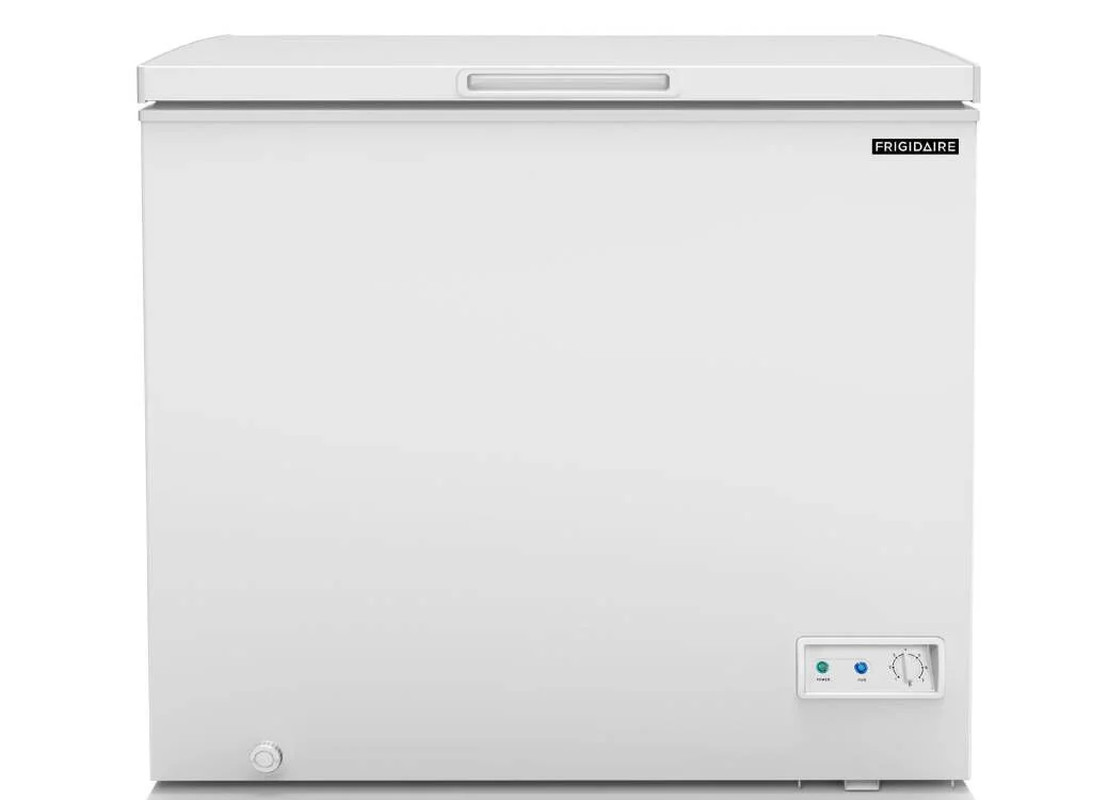

Photos from current listings. Actual item, color, and included accessories may vary.
Chest Freezer Buying Guide
A chest freezer is a top-loading appliance that stores bulk frozen food at consistent temperatures, usually cheaper to buy and run than an upright. The main trade-off is manual defrost versus frost-free convenience, plus garage-readiness versus indoor-only rating. Choose a manual-defrost, garage-rated model with a thick insulated lid if durability and low running cost matter; skip budget frost-free cabinets placed in unheated spaces.
At a glance
- Category
- Home Appliances
- Last updated
- Nov 22, 2026
Current offers
Highlights
- Manual-defrost chest freezers use static cooling coils and a drain plug; frost-free models add fans and heaters but dry food and cost more to run.
- Garage-ready units are rated for ambient temperatures from roughly 0°F to 110°F; standard freezers lose cooling capacity below 40°F.
- Foam-injected walls and lids commonly reach 2.0–3.0 inches thick; thicker insulation directly reduces duty cycle and energy use.
- Most full-size chest freezers draw 1.5–2.5 amps at 115V and need a dedicated 15-amp circuit; compact models run under 1 amp.
Best use cases
- Best fit: bulk beef or half-hog buyers — pick a 7–9 cu ft manual-defrost garage-ready chest freezer with a basket and power indicator light.
- Best fit: garage or unheated mudroom placement — choose a freezer explicitly rated for garage use; skip indoor-only cabinets that fail below 40°F.
- Wrong fit: frequent open-and-close family use in a warm kitchen — choose an upright frost-free model instead; chest freezers lose cold air slowly but are awkward to organize.
Buying tips
- Size by volume: allow 1.5–2.5 cu ft per person for supplemental storage, and add 1 cu ft per 20 lb of bulk meat you plan to freeze.
- Pick manual defrost unless convenience is critical; defrost once or twice a year and save 10–15% on energy versus frost-free.
- Confirm the lid uses a counterbalanced hinge and at least 2 inches of insulation; thin lids frost at the rim and cycle constantly.
- Match the plug to a dedicated 115V/15A grounded outlet; do not share the circuit with a refrigerator or microwave.
Specs
| Defrost Type | Manual drain vs frost-free |
|---|---|
| Ambient Rating | Garage-ready 0–110°F vs indoor-only |
| Capacity Range | 5–25 cu ft; 7 cu ft compact |
| Power Draw | 115V, 1.5–2.5A, 15A circuit |
What to check before buying
- Measure the opening: add 2–4 inches of clearance on all sides and above the lid for airflow and hinge swing.
- Verify the floor can carry a loaded freezer: a 7 cu ft model weighs roughly 200–250 lb full.
- Check ambient rating versus your space: garage-ready for below 40°F, standard indoor rating only for heated rooms.
- Confirm a 115V grounded outlet within reach; most chest freezers ship with a 5–6 ft cord.
FAQ
Data sources: eBay / Amazon listings and product attribute feeds. Updated Nov 22, 2026.
Some links on this page are affiliate links. If you buy after clicking one, we may earn a commission at no extra cost to you. This does not change which products appear here or their order. Affiliate disclosure.