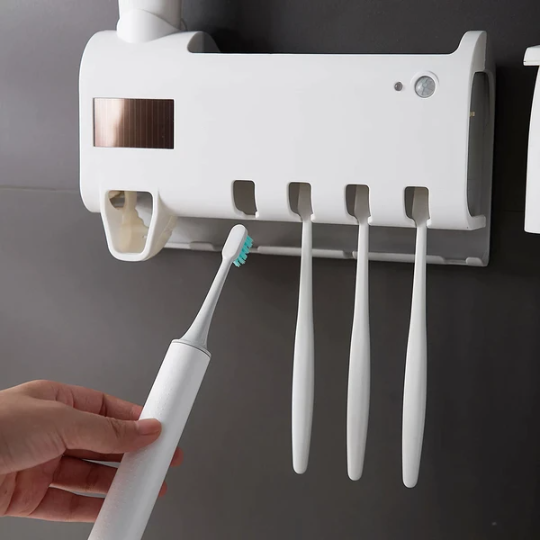

Photos from current listings. Actual item, color, and included accessories may vary.
Automatic Toothpaste Dispenser Buying Guide
An automatic toothpaste dispenser is a wall-mounted or countertop unit that uses a pump or vacuum mechanism to dose toothpaste onto a brush, often combined with UV toothbrush sterilization. The core trade-off is between mechanical pump reliability (vacuum piston vs. motorized) and build quality (ABS vs. food-grade silicone contact parts), since cheap pumps clog with dried paste and UV bulbs lose intensity. The clear rule: choose a vacuum-pump ABS unit with a removable, dishwasher-safe paste chamber for daily family use; skip motorized or unsealed units unless you need hands-free operation for limited mobility.
At a glance
- Category
- Bathroom Accessories
- Last updated
- Nov 22, 2026
Current offers
Highlights
- Vacuum-piston dispensers dose by air-pressure squeeze and work without power; motorized versions need batteries and add failure points at the gearbox.
- Toothpaste contact parts should be food-grade silicone or PP; standard ABS housings are fine but bare plastic pump chambers crack under repeated paste drying.
- UV-C sterilizer models use 2-4 mW/cm² bulbs that degrade after roughly 6-12 months of daily cycles, so replaceable bulbs matter more than advertised wattage.
- Wall-mount units need a flat, non-porous tile or glass surface; suction-cup mounts fail on textured or matte surfaces, so screw-in or adhesive plates are the durable choice.
Best use cases
- Best fit: family bathroom with 2-4 daily users — pick a vacuum-pump wall-mount with a 100-150 ml paste reservoir and 4-5 brush slots to eliminate counter clutter.
- Wrong fit: renters with textured or painted walls — skip suction-cup mounts and choose a freestanding countertop unit or adhesive-plate model that removes cleanly.
- Best fit: kids or limited-mobility users — a motorized touch-free dispenser with a fixed dose (0.5-1.0 g) reduces waste and hand strength needed; pair with a low-mounted bracket.
- Wrong fit: households using thick or whitening pastes — skip narrow-nozzle dispensers and choose a wide-bore pump (8-10 mm) or manual tube-squeezer to avoid clogging.
Buying tips
- Measure your toothpaste tube neck: standard 28-32 mm threaded necks fit most dispensers; narrow 20 mm travel-tube necks need an adapter ring or a different unit.
- For wall mounting, confirm tile or glass surface and choose screw-in anchors for loads over 1 kg; adhesive plates need 24 hours cure time before loading the reservoir.
- Pick a paste chamber that removes without tools and is top-rack dishwasher safe — this is the single biggest predictor of long-term hygiene and clog avoidance.
- Match UV sterilizer to brush count: 4-slot units fit standard and electric brush heads; 6-slot units need a wider 18-20 cm footprint and are better for shared family baths.
Specs
| Dispense Mechanism | Vacuum piston vs motorized pump |
|---|---|
| Mount Type | Wall adhesive/screw vs freestanding |
| Paste Reservoir | 80-150 ml removable chamber |
| UV Sterilizer | 2-4 slots, replaceable UV-C bulb |
Related searches
What to check before buying
- Measure wall space and mounting surface: confirm at least 10 cm clearance below the dispenser for brush handles and a flat, non-porous area for adhesive or screws.
- Check toothpaste tube compatibility: verify the unit accepts your tube's neck diameter and paste viscosity (gel vs. thick whitening paste).
- Confirm power needs: UV models require a nearby GFCI outlet or USB adapter; battery models need AA/AAA cells and are not waterproof at the battery door.
- Verify brush head fit: electric brush heads are wider than manual brushes — measure slot width (typically 2.5-3.5 cm) before buying a sterilizer combo.
FAQ
Data sources: eBay / Amazon listings and product attribute feeds. Updated Nov 22, 2026.
Some links on this page are affiliate links. If you buy after clicking one, we may earn a commission at no extra cost to you. This does not change which products appear here or their order. Affiliate disclosure.