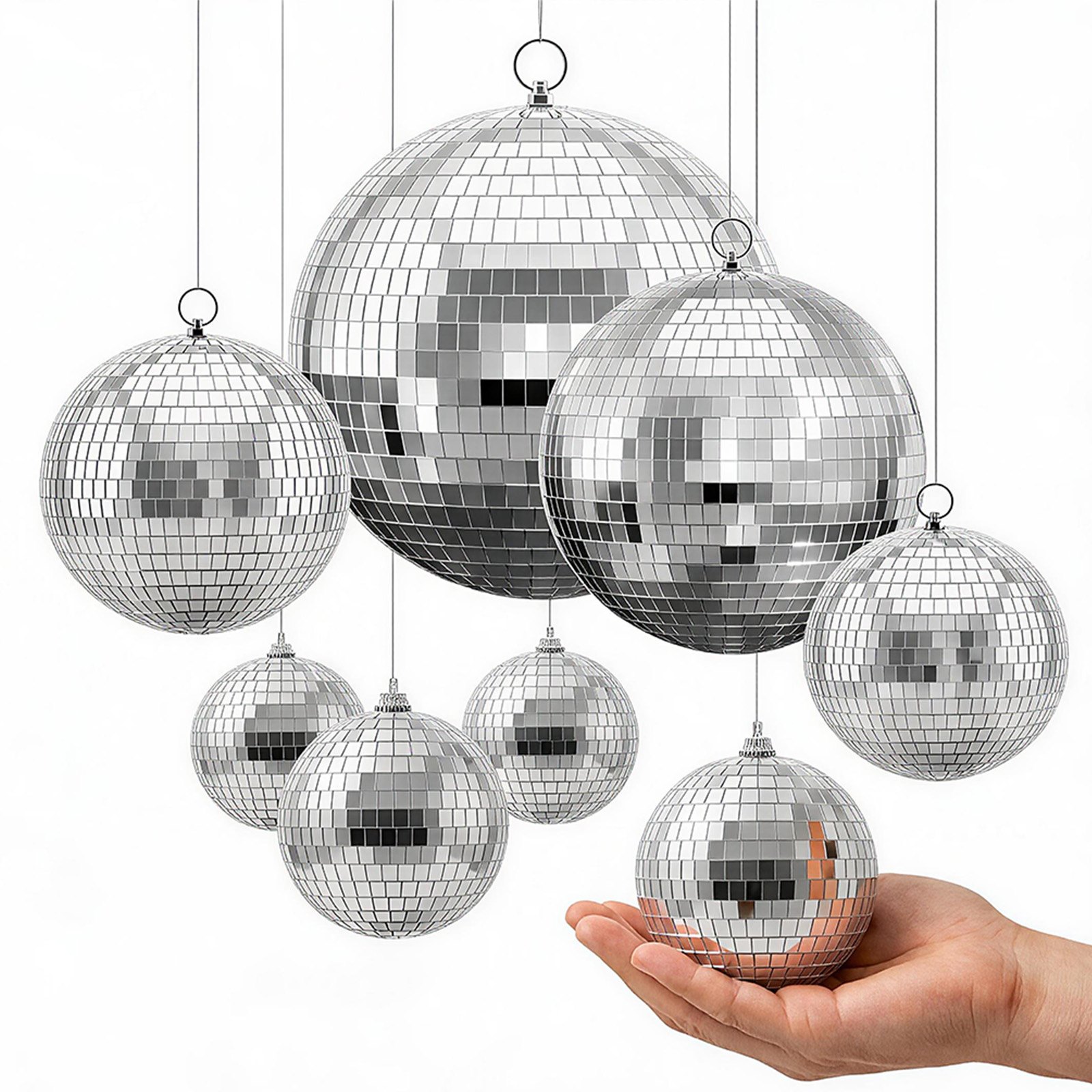

Photos from current listings. Actual item, color, and included accessories may vary.
Disco Ball Buying Guide
A disco ball is a mirrored sphere that reflects light into moving specular highlights, and its performance hinges on mirror tile size, coverage density, and core construction rather than diameter alone. The key trade-off is between large tiles (broad, bold reflections) and small tiles (fine, shimmering scatter) at a given ball size. Choose by matching tile scale to viewing distance and mounting method: dense small-tile balls for close-up sparkle, large-tile balls for stage-scale throw.
At a glance
- Category
- Mirrors, Wall Decor & Decorative Accessories
- Last updated
- Nov 22, 2026
Current offers
Highlights
- Tile size drives reflection character: 10 mm tiles give fine shimmer for indoor home use, 20 mm tiles give bold stage throw visible from 10+ m.
- Coverage density matters more than diameter: a fully tiled 4-inch ball outperforms a sparse 12-inch ball for continuous light scatter.
- Core construction separates durable from disposable: rigid foam or hollow plastic cores hold shape; thin blow-mold shells dent and shed tiles under handling.
- Hanging hardware is a failure point: a welded metal ring or swivel motor mount beats glued plastic loops that crack under rotation.
Best use cases
- Home parties and small rooms: pick a 4–8 inch ball with 10 mm tiles and a simple ring hanger; skip 12-inch stage balls that overwhelm a living room ceiling.
- DJ booths and club stages: pick a 12-inch or larger ball with 20 mm tiles and a motor mount rated for continuous rotation; skip lightweight party-store balls that wobble at speed.
- Photography and content creation: pick a small 4–6 inch ball with dense small tiles for controlled specular highlights; skip oversized balls that cast harsh, unmanageable hotspots.
Buying tips
- Match ball diameter to throw distance: 4–6 inch for rooms under 5 m, 8–12 inch for halls and stages, 16 inch+ for large venues.
- Choose tile size by effect: 10 mm tiles for fine glitter at close range, 20 mm tiles for bold beams visible across a large floor.
- Verify tile adhesion method: factory-glued tiles on a rigid core resist shedding; self-adhesive tiles on soft shells peel in heat and humidity.
- Confirm the hanger type: a metal ring welded or bolted to the core supports a motor; a glued plastic loop is for static hanging only.
Specs
| Tile Size | 10 mm fine / 20 mm bold |
|---|---|
| Core Material | Rigid foam / hard plastic shell |
| Hanger Type | Welded metal ring vs glued loop |
| Diameter Range | 4–16 in (10–40 cm) typical |
Related searches
What to check before buying
- Ceiling height: a hanging ball needs at least 30 cm clearance below the mount plus rotation radius for motorized setups.
- Mounting surface: confirm a stud or rated anchor point for balls 8 inches and above; drywall alone will not hold a rotating 12-inch ball.
- Light source: position a spotlight or moving head 1–2 m from the ball for maximum specular scatter; ambient room light washes out reflections.
- Companion parts: a motor, swivel, and safety cable are separate purchases for rotating installations; static hanging needs only a hook and line.
FAQ
Data sources: eBay / Amazon listings and product attribute feeds. Updated Nov 22, 2026.
Some links on this page are affiliate links. If you buy after clicking one, we may earn a commission at no extra cost to you. This does not change which products appear here or their order. Affiliate disclosure.